
Nowt So Queer As Here
Where love speaks its name loud and proud

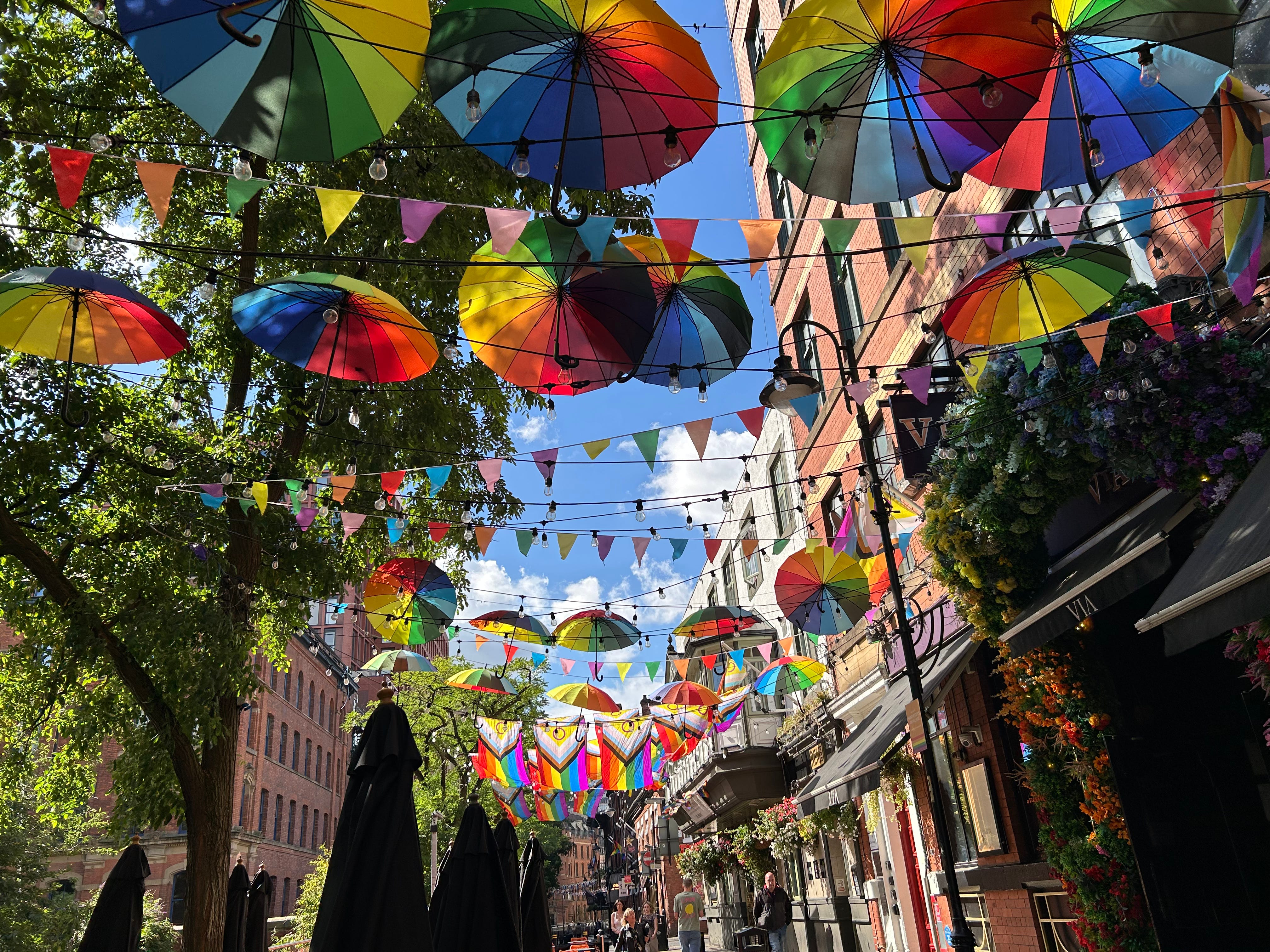
Above: Canal Street, Manchester, 2 September 2025. Foreground: Umbrellas featuring the rainbow colours of LGBT Pride. Background: inclusive flags featuring the LGBT rainbow; the black, brown, blue, pink, and white stripes of transgender Pride; and the purple circle on yellow field of intersex Pride.
This essay is dedicated to Tom Trice, who helped me appreciate the magic that happens at the intersection of queer history, urban history, and the history of social movements. The latter part of the essay narratives a dérive undertaken on 2 September 2025 by myself, Michelle Call, and Annie Bracken.1
London may be the capital of the United Kingdom, but the capital of gay Britain must surely be Manchester. Weirdly, London doesn’t even have a clearly defined gay quarter.2 This means that Manchester’s Gay Village really can claim to be the centre of queer culture and politics not just for the North, but for all of Britain. The Campaign for Homosexual Equality began in Manchester in the 1960s. In the late 1970s and early 80s, the infamously homophobic Greater Manchester Police Chief James Anderton ordered raids on the city’s gay bars. In 1984, in an event reminiscent of the Stonewall Riots in New York City fifteen years earlier, about twenty transvestites resisted a police raid at a club called Napoleon’s.3 As Kevin Darbyshire argues, “The raid created an alliance between the city’s gay community, the City Council and gay businesses who attempted to promote a more gay friendly city.”4 It took the full strength of Britain’s gay liberation movement combined with the political power of a city council that recognised the potential economic value of a gay consumer district to make the Gay Village a reality.
In 1988, Margaret Thatcher’s Conservative government passed a Local Government Act which included the appallingly homophobic Clause 28. This clause prohibited local governments from “promoting homosexuality,” and it prohibited schools from teaching “the acceptability of homosexuality as a pretended family relationship.” The results were entirely predictable. Since the Tories could not provide a coherent definition of the word “promoting”—or for that matter, “homosexuality”—many British teachers simply stopped discussing LGBT sexualities in their classrooms altogether.
Meanwhile in Manchester, a Labour city council led by Graham Stringer began deliberately courting the city’s gay community as natural allies against Thatcherism.5 In July 1988, some 20,000 Britons gathered in Manchester to protest Clause 28. This was the largest LGBT demonstration that Britain had ever seen.6 Demonstrators rallied at St Peter’s Square. The programme for the rally listed a number of gay-friendly venues around Canal Street where protesters could go and party after the rally. Ever since then, this remarkable neighborhood in Manchester’s post-industrial city centre has been known as the Gay Village.
When Clause 28 came into effect in 1988, the national government and even many local authorities in the North were so homophobic that Manchester City Council looked “particularly unstinting in its support of lesbians and gays.”7 For example, Rochdale Council banned advertising for lesbian and gay counselling and support services in its libraries in 1980, but Manchester Council permitted such advertising in Manchester libraries.8 Today, Manchester Central Library is hosting Acting Up! 40 Years of HIV Activism (see below). Whilst many local councils throughout Britain embraced Thatcherite homophobia in the late 80s, Manchester City Council viewed Clause 28 not only as an attack on a vulnerable sexual minority of queer Mancunians, but also as an assault on the ethical values of the council itself.9 Naturally, the council were also mindful of the economic importance of Manchester’s gay community, both in terms of the potential benefit of “pink pound” gay consumer spending to local businesses, and also in terms of marketing post-industrial Manchester as a progressive, cosmopolitan city.10 As Kevin Darbyshire argues, these economic concerns were what finally moved the city council, in 1991, to recognize the Gay Village as “a unitary entity significant in planning terms.”11 This was unprecedented. When the city government acknowledged the Gay Village as an official urban planning unit, the village gained access to substantial publicity, marketing, and economic development resources.
The most effective and symbolically important thing the city council could do to promote the Gay Village was also the simplest and the cheapest. In 1991, Manchester began issuing official city maps which labeled the area around Canal Street “Gay Village.”12 After drag queens fought gay-bashing police during the 1969 Stonewall riots, New York’s Greenwich Village was still called Greenwich Village. But in 1991, the city of Manchester actually named its gay village the Gay Village. Because of course they did. For Mancunians are brash and blunt and working class and above all else, they are Northerners. When they stand up for what they know is right—which they do frequently—they start by giving things their proper names. And because they have been calling their Gay Village what it is since the 1990s, that village now “symbolises the outward-looking confidence of the modern gay community, its culture not only tolerated but celebrated,” as Alan Kidd argues.13 By the mid-1990s, gay Mancunians identified their splendid city as a tolerant and diverse place that eagerly partook of the “friendliness” and mutual aid that is such an important part of working-class culture in the North. By the time Queer as Folk debuted on Channel Four in 1999, Russell T Davies was able to represent the Gay Village “as a utopian hedonistic gay male space, absent from violence, tolerant and cosmopolitan.”14
Of course, a utopia always includes its dystopian opposite. As Nina Held has argued, space in the Gay Village is commodified in such a way that “white, middle-class, gay men seem to be the users who can feel most comfortable in the space.”15 Sadly, the village has not always been welcoming to women. Lesbians were essentially invisible there through the 1990s. Until Vanilla opened late in 1998, there were no women-only venues in the district.16 In the early 2000s, after Queer as Folk had raised Britain’s awareness of the Gay Village, large numbers of straight tourists began visiting. This lead to what Annette Pritchard calls the “degaying” of Gay Village.17 Lesbians faced unwelcome advances from straight men, and patriarchal attitudes from some gay men.18 In this context, many women felt that with Vanilla they had created not just an important sanctuary for lesbians, but also, ironically, “one of the most gay spaces in the Village.”19
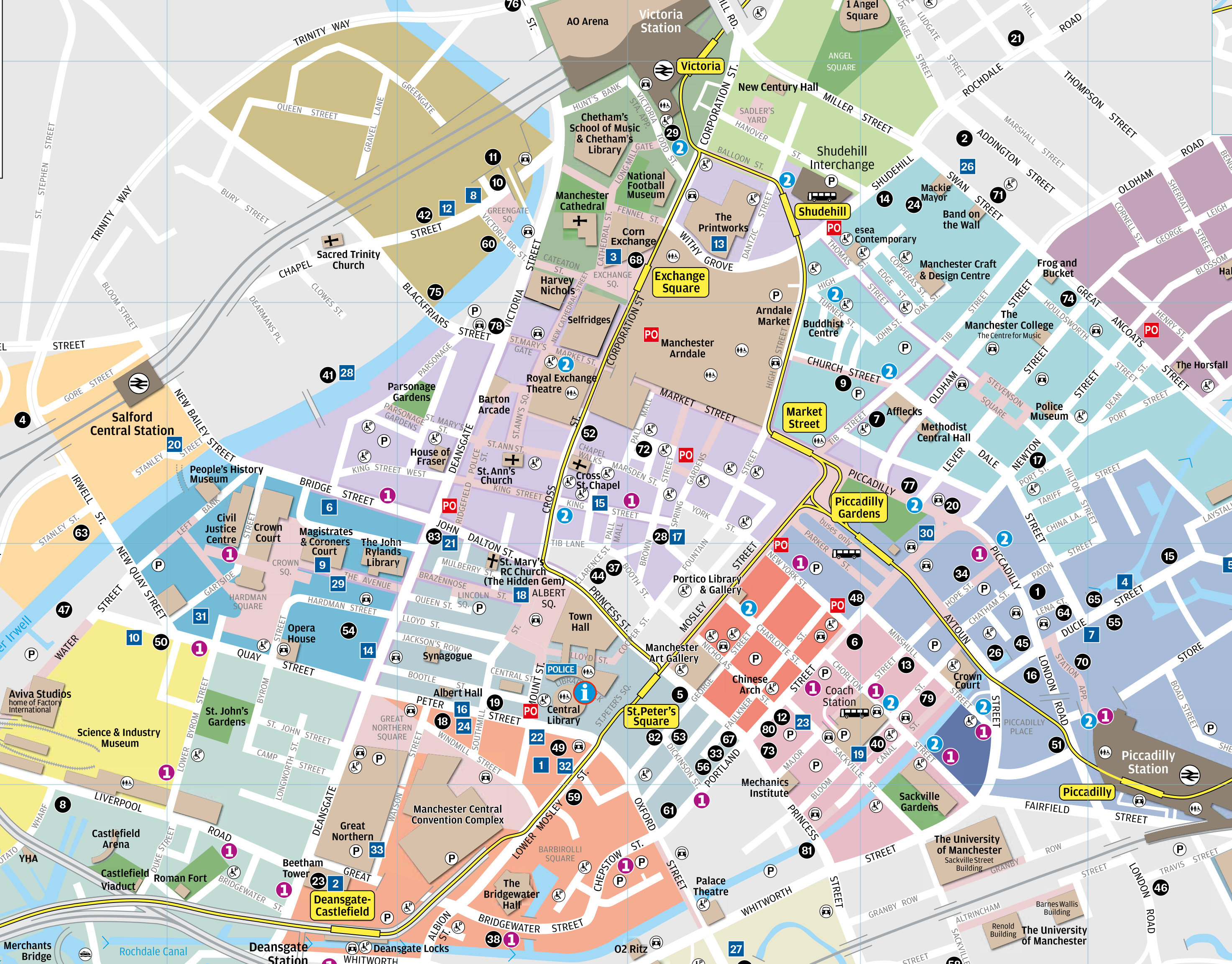

Above: “Marketing Manchester” map, August 2024. The Gay Village is shown in pink around Sackville Gardens, lower right.
Imagine my delight when I discovered that the canal along which runs the Gay Village’s famous Canal Street is our very own Rochdale canal! Until the 1980s, the area around Canal Street “was full of cotton workers by day and prostitutes by night,” according to Peter Bessick, the former landlord of the Rembrandt.20 It’s no surprise that the neighborhood was mainly inhabited by workers from the cotton and sex industries. Indeed, as the cotton mills shut, many unemployed mill workers, men and women, likely turned to sex work. In the first half of the twentieth century, the decline of the English textile industry also led to de-industrialization and de-population in the area of Manchester city centre that would eventually become the Gay Village. As Held argues, the Gay Village happened because Manchester’s marginalized gay community appropriated the de-industrialized space around the Rochdale Canal at a historical moment when progressive cities around the world were starting to promote commodified gay spaces.21 And Manchester was one of the most progressive.
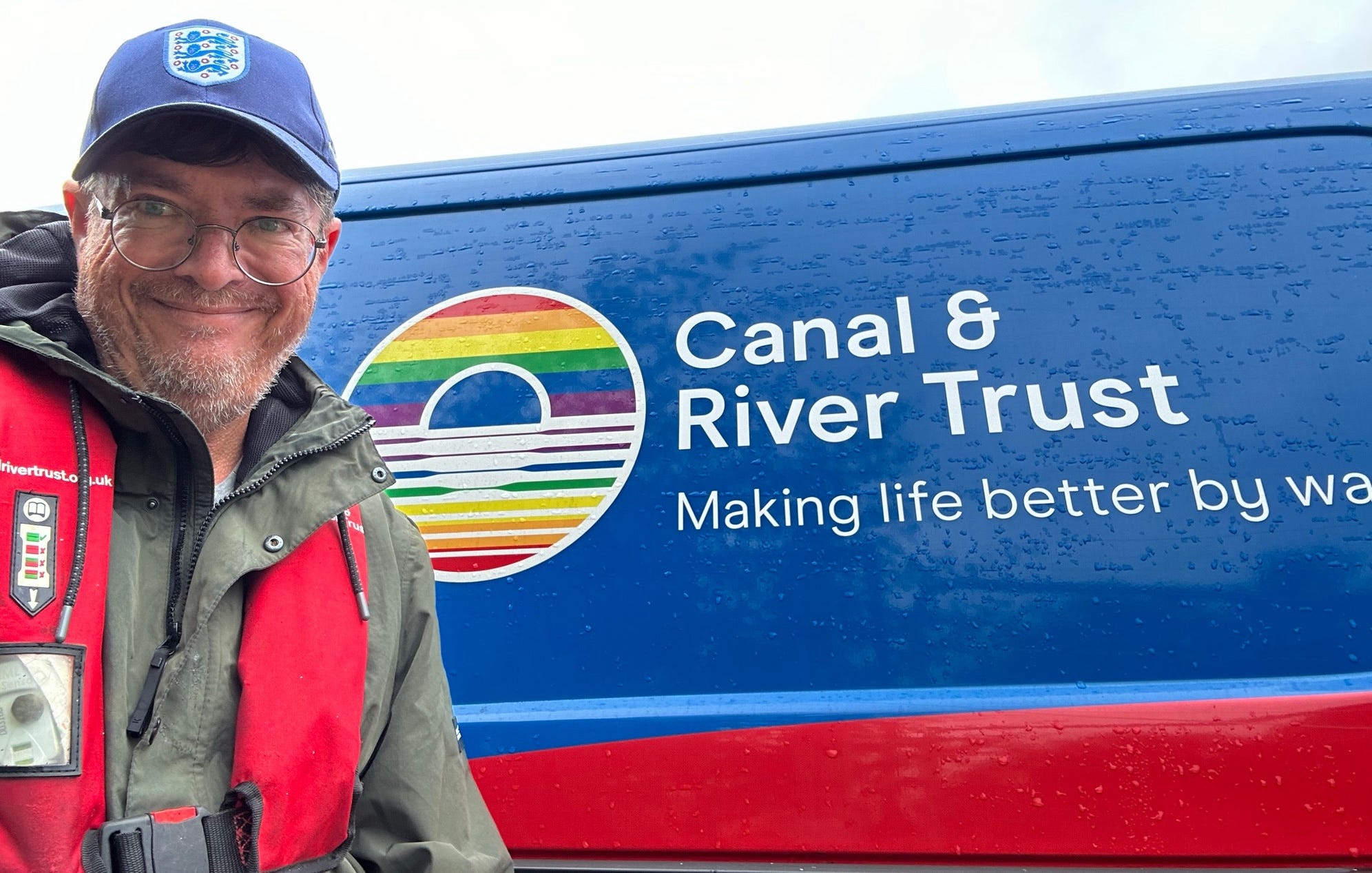
Today, the Rochdale Canal towpath serves as kind of symbolic yellow brick road, leading from the Kansas-like fields of east Lancashire right into the glittering Oz of Gay Village! I recently joined the Canal and River Trust’s Littleborough Towpath Taskforce, a volunteer group that maintains and cares for the section of the towpath that runs through my town. When I arrived for my first meeting, I was delighted to see that they had brought the rainbow van!
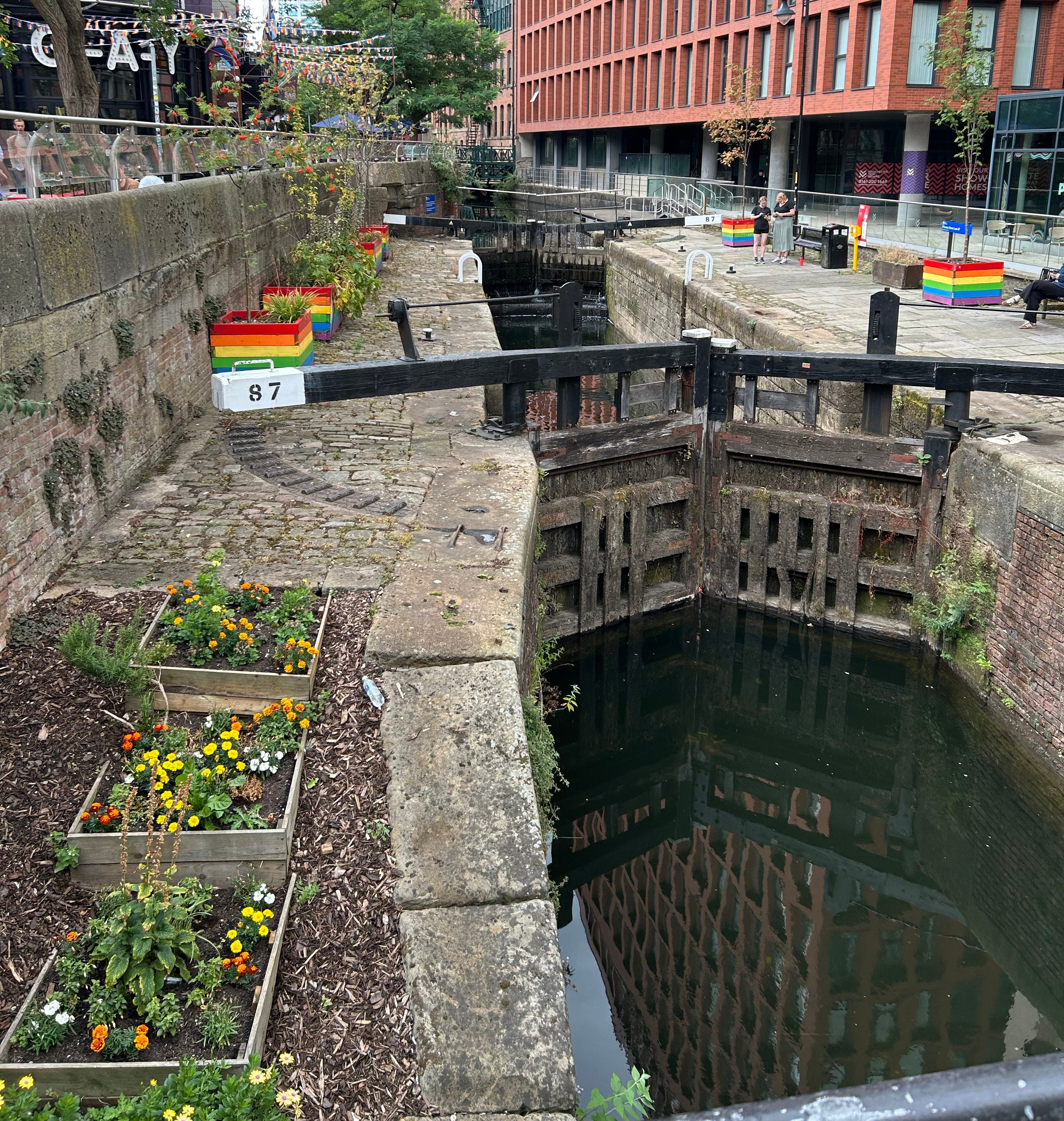
One of the other Canal and River Trust volunteers told me that a week or two before Manchester Pride, they had gone down to Gay Village, to make sure that everything was in order for the big event. Job well done! The stretch of the canal towpath around Locks 86 and 87 is lined with planter boxes featuring brightly painted rainbow Pride banners, and these are filled with equally colourful flowers.
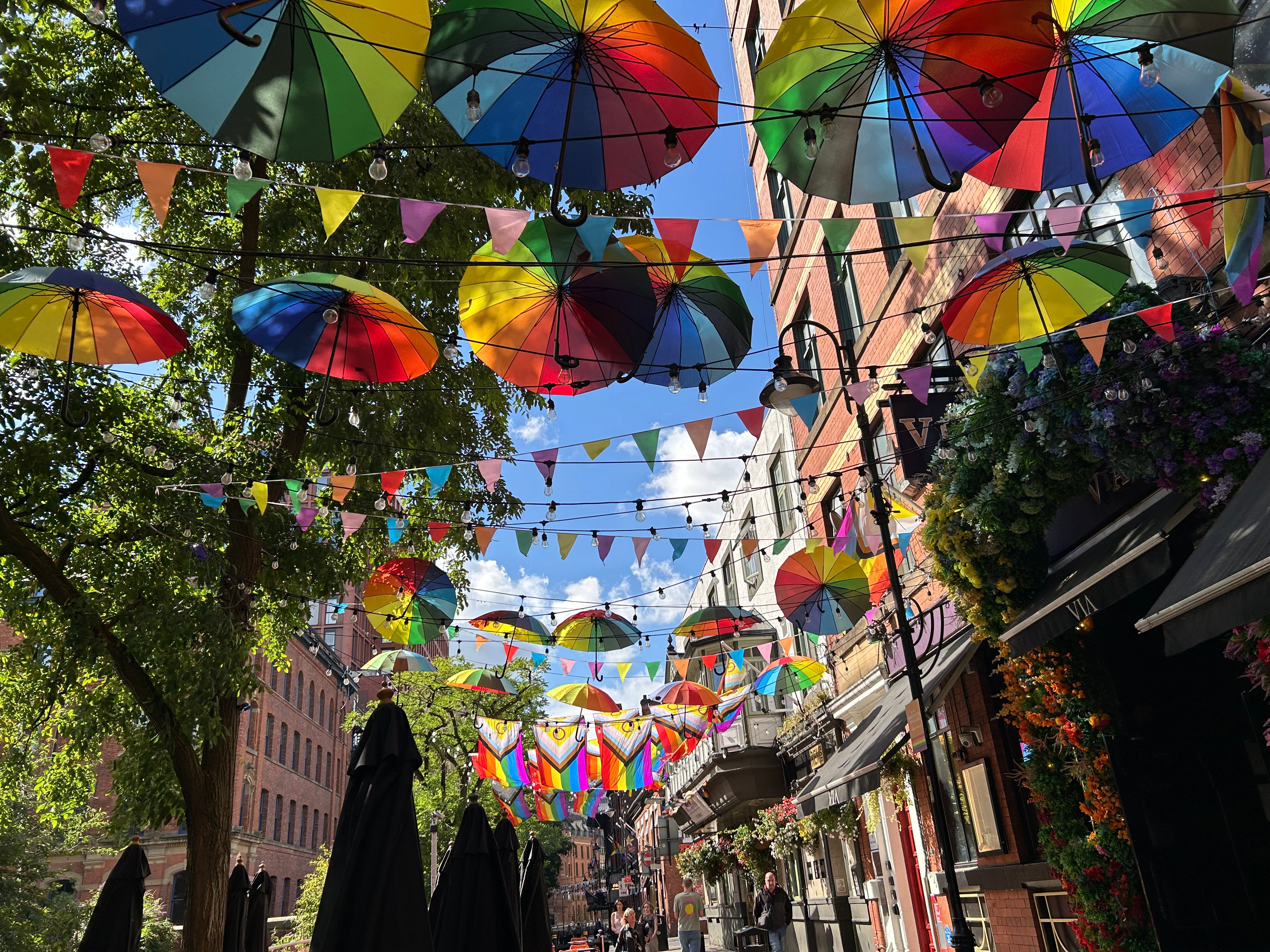
Canal Street is a joyous riot of rainbows. Brilliant rainbow parasols suspended above the pedestrian pavement might have shielded us from the rain, had there been any on this glorious afternoon in early September.
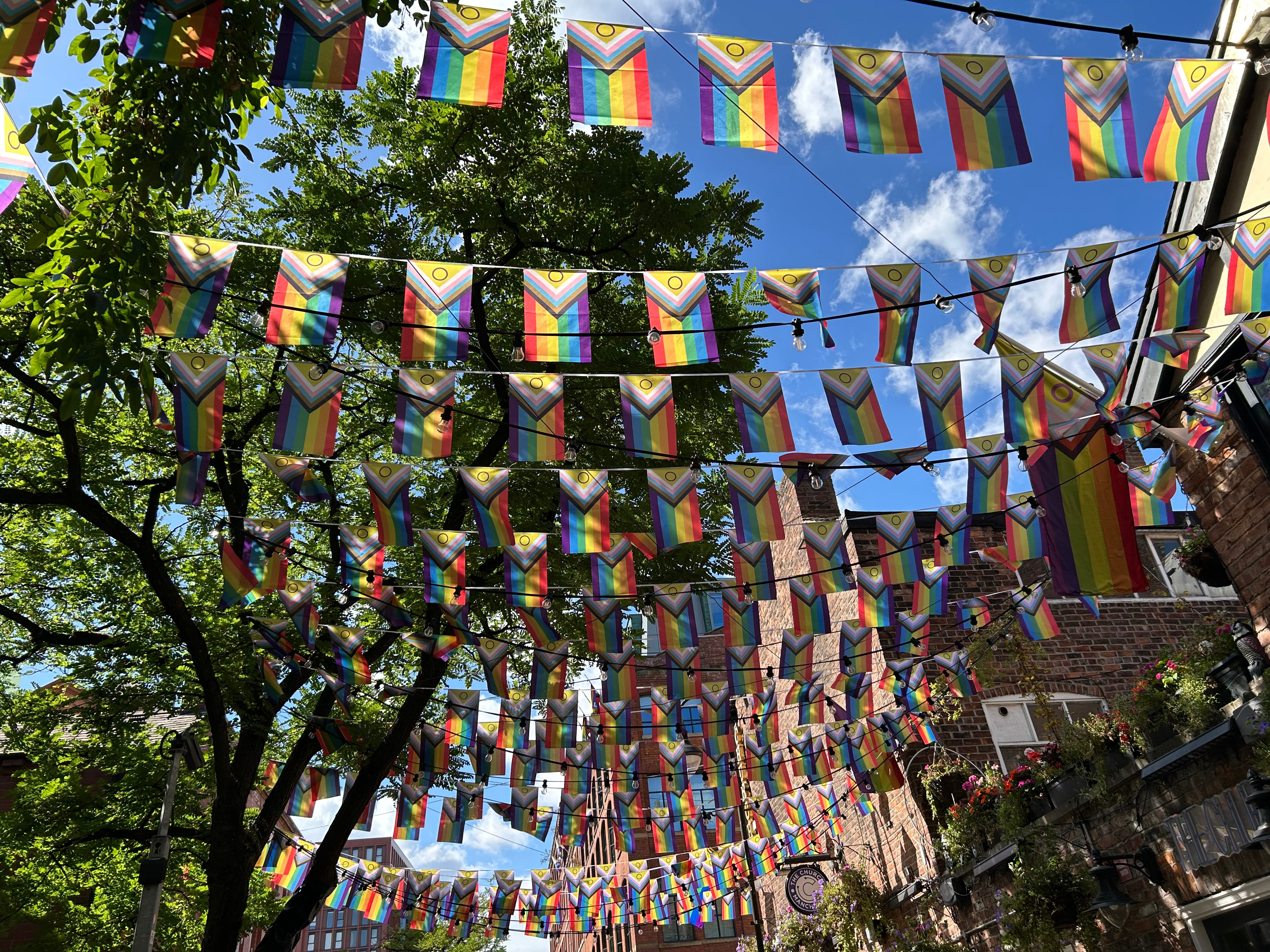
The Gay Village flies a diverse array of Pride colours. The most common flag is also the most inclusive one. It features the classic rainbow of LGBT Pride; the black, brown, blue, pink, and white stripes of transgender Pride; and the purple circle on yellow field of intersex Pride. I am happy to see that Canal Street is so inclusive with respect to gender and sex. But I hope that more will be done in future to include queers of colour, who have long been invisible. Mancunian Gay magazine was published from 1981-1985. During that time there was only one gay Black man on its cover, and it was the American novelist James Baldwin, who is certainly not a Mancunian, or even English.22 Sadly, the Gay Village remains fairly white today. Nina Held’s research has shown that by trying to imagine Gay Village as a “racially neutral” space, white Mancunians have constructed the gay subject as inherently white, while ignoring their own racializing practices.23
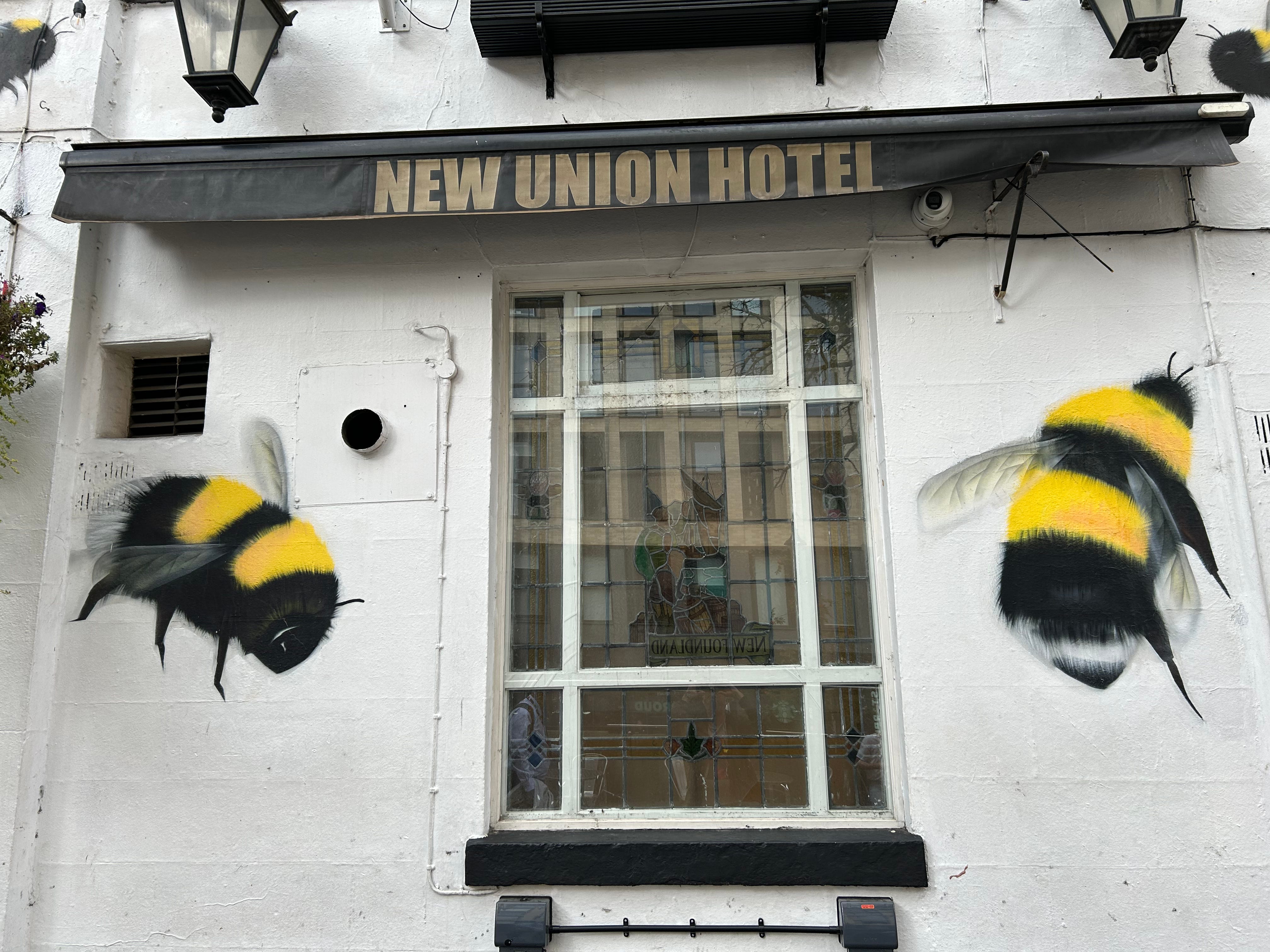
Above: The side of the New Union Hotel facing Canal Street, decorated with Manchester worker bees.
In England as in America, the modern gay rights movement began at a slightly seedy gay bar that just happened to be in the right place at the right time. In America that was the Stonewall Inn in Greenwich Village, New York City. In England, it was the New Union Hotel and Pub, which occupies a whole block at the corner of Canal Street and Princess Street in Manchester. It is one of the oldest gay pubs in Manchester. When it opened in 1959, it was the only pub on Canal Street.24 Already in the early 1960s, New Union Pub had a reputation as a place where “pansies” went to drink.25 In 1965, the landlord was jailed for such supposed “crimes” as allowing “‘men dressed as women’ to ‘writhe in a sexy way’ on stage and to tell ‘filthy jokes.’”26 Oh, the horror! But while the police were busy prosecuting imaginary crimes like drag, they were ignoring the very serious actual crimes that were all too common in the area around New Union. There was a great deal of gay-bashing violence and even the occasional murder. Happily, something good did come about in response to this appalling homophobia. In the finest tradition of Northern mutual aid, “A working-class community of queers, queens, lesbians, drag queens and sex workers” formed and began to take care of one another.27 Ironically, both the notoriety and the resulting sense of community solidarity made New Union more popular than ever. Community meetings held in a room above the pub brought students and hippies from the nearby universities together with proletarian sex workers and drug users to create a sense of solidarity between social classes.28 The first skirmish in Manchester’s gay revolution may have been fought at Napoleon’s in 1984, but that was a “men’s only” bar. New Union was for everyone. By the early 2000s, as one woman in Annette Pritchard’s study said, “Places like the New Union are fine because everybody mixes and it’s easy going.”29
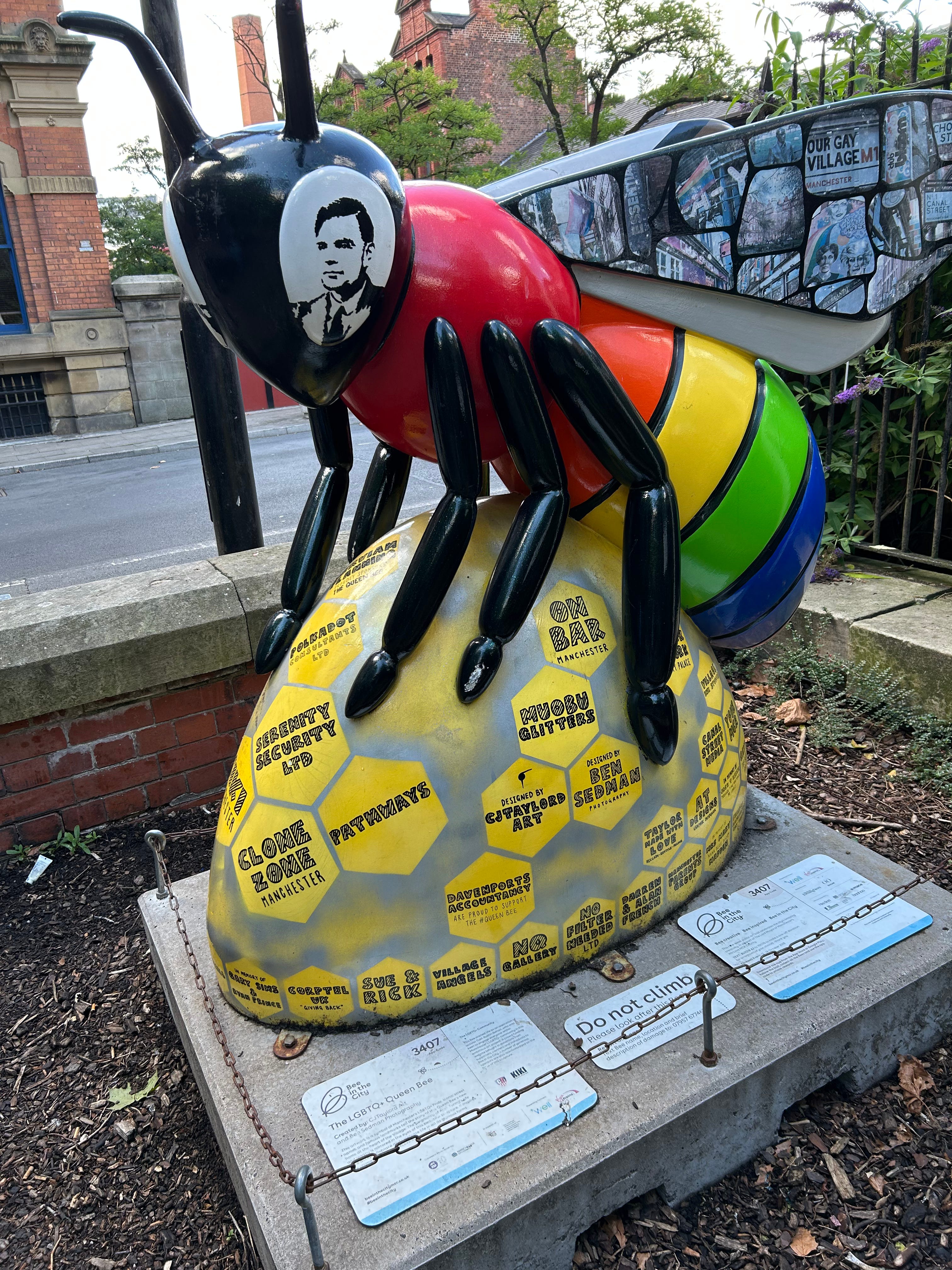
Above: “The LGBTQ+ Queen Bee,” designed by CJTaylord Art and Ben Sedman Photography. Alan Turing gazes out of the eyes of the bee. Sackville Gardens.
Sackville Gardens was laid out in 1990, and it soon became the centre of Manchester’s Pride celebrations.30 Matt Cook and Alison Oram argue that “In the early to mid-1990s there was for many the feeling of something new and exciting emerging in this part of the centre.”31 Sackville Gardens features the very first statue and memorial for Alan Turing. The incredible Dr Turing broke Nazi Germany’s Enigma code at Bletchley Park during World War Two, making a major contribution to the Allied war effort which certainly shortened the war and saved many lives.32 In 1949, Turing came up to Manchester, where he became Deputy Director of the University of Manchester’s Computing Machine Laboratory. Here he helped design some of the world’s first stored-program computers.
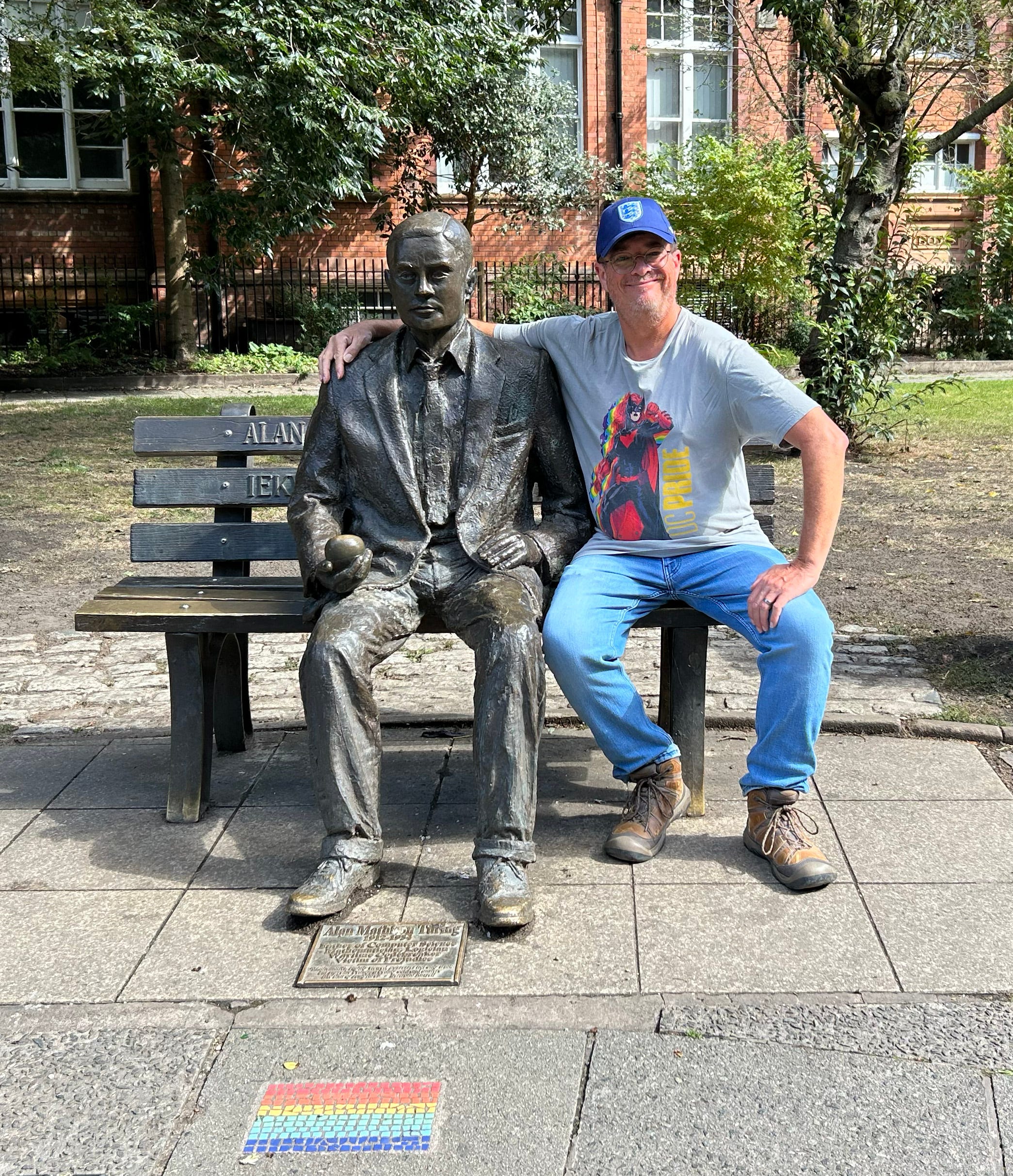
Above: Me and my buddy Alan Turing at Sackville Gardens, 2 September 2025. Turing’s old Amstrad computer is buried beneath the rainbow “keyboard” mosaic set into the flagstone, foreground.
In 1952, Turing was charged with “gross indecency” (i.e., having sex with another man) under Britain’s barbaric Criminal Law Amendment Act 1885. He pled guilty. Given a choice between imprisonment and chemical castration, he reluctantly chose the latter. Turing lost his security clearance at GCHQ (General Communications Headquarters, the British signals intelligence agency). It is a tragic irony that the man who did more than any other to win the war for Britain by breaking the Nazis’ “unbreakable” codes was now seen as a national security risk. In 1954, Turing killed himself by taking cyanide in an apple. Queen Elizabeth II granted him a posthumous Royal Pardon in 2013. The 2017 “Alan Turing law” granted such retroactive pardons to men who had been convicted under Britain’s homophobic laws. In 2021, the Bank of England put Turing on the back of the £50 note. All very nice, I’m sure. But perhaps Turing’s greatest legacy is this: gay students, faculty, and staff at Manchester’s universities may now openly practice the love which still dared not speak its name in Turing’s time. Frozen in time by sculptor Glyn Hughes, Alan Turing now sits quietly upon a park bench in Sackville Gardens, the epicenter of a Gay Village that speaks its name quite loudly indeed.
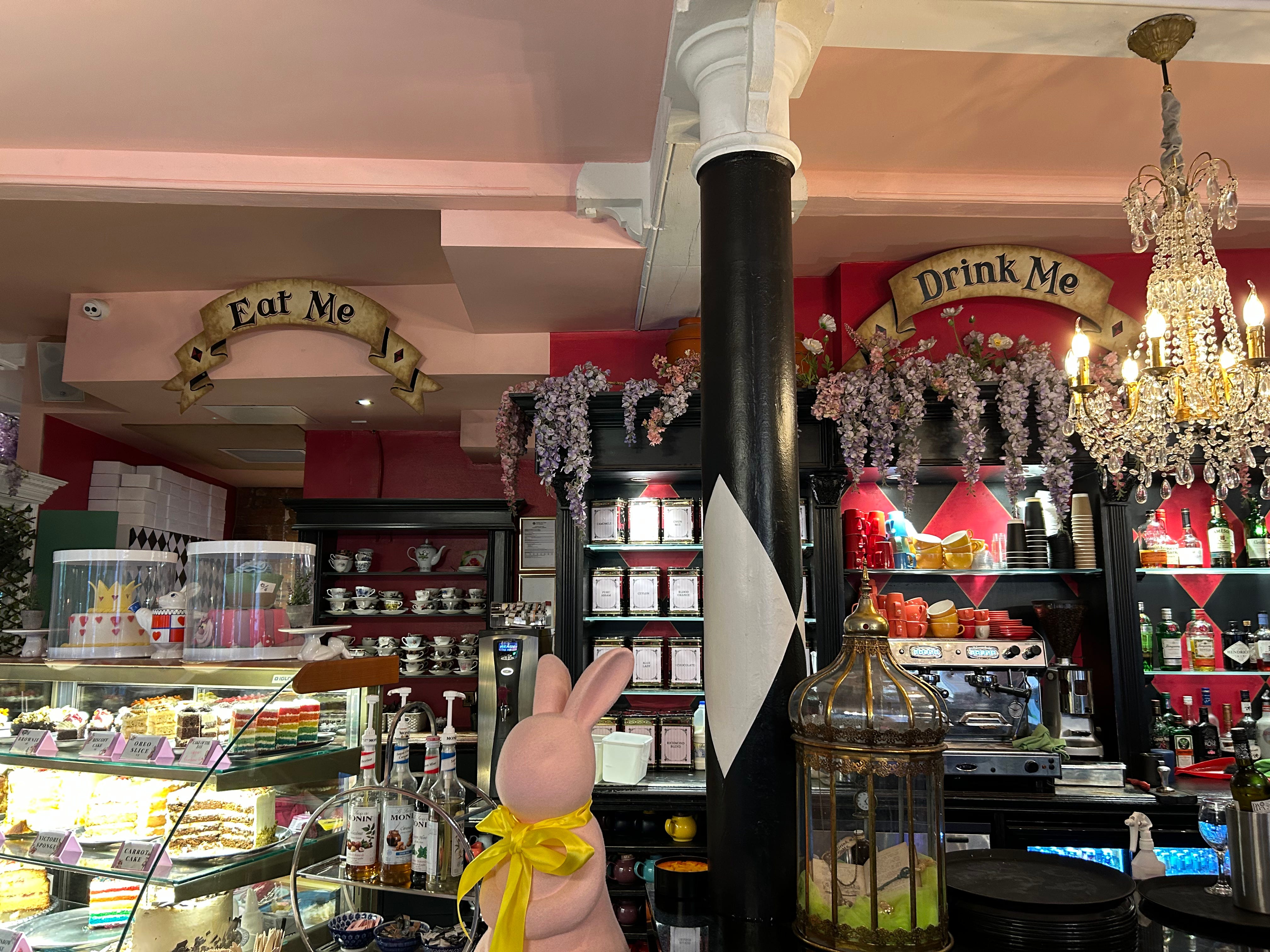
Across from Sackville Gardens is the Richmond Tea Rooms. We took our dinner here, in a delightfully rococo dining room designed around an “Alice in Wonderland” theme.33 The large “Eat Me” sign above and behind the pastry case is a floating signifier that connotes both drug use and oral sex, while flying literally and figuratively right over the heads of the adorable little English girls enjoying high tea with their mummy at the next table. This is perhaps part of the phenomenon whereby “The more threatening, less easily assimilated aspects of urban sexual dissidence are rendered invisible – and most specifically the sexual side of gay men’s urban cultures are downplayed” in order to make the Gay Village feel like a safe space for straight consumers.34 There was a party of twenty-five women in the function room—maybe a lesbian wedding reception or rehearsal dinner? Or possibly one of the straight “hen parties” that have been annoying gay Mancunians in the village since the mid-90s?35 In any case, the demands of serving this large and boisterous group of women delayed the arrival of our food considerably, which was fine, as we had no plan or objective and hence no deadline. Viva la dérive! Still, the young gay lad serving us quite thoughtfully comped our drinks and took ten percent off the bill, so dinner at this posh touristy tea room turned out to be surprisingly affordable. And delicious! If you ever start to feel a bit peckish when you’re wandering around Sackville Gardens, I recommend you head for the Richmond Tea Rooms and try Alice’s rarebit.36
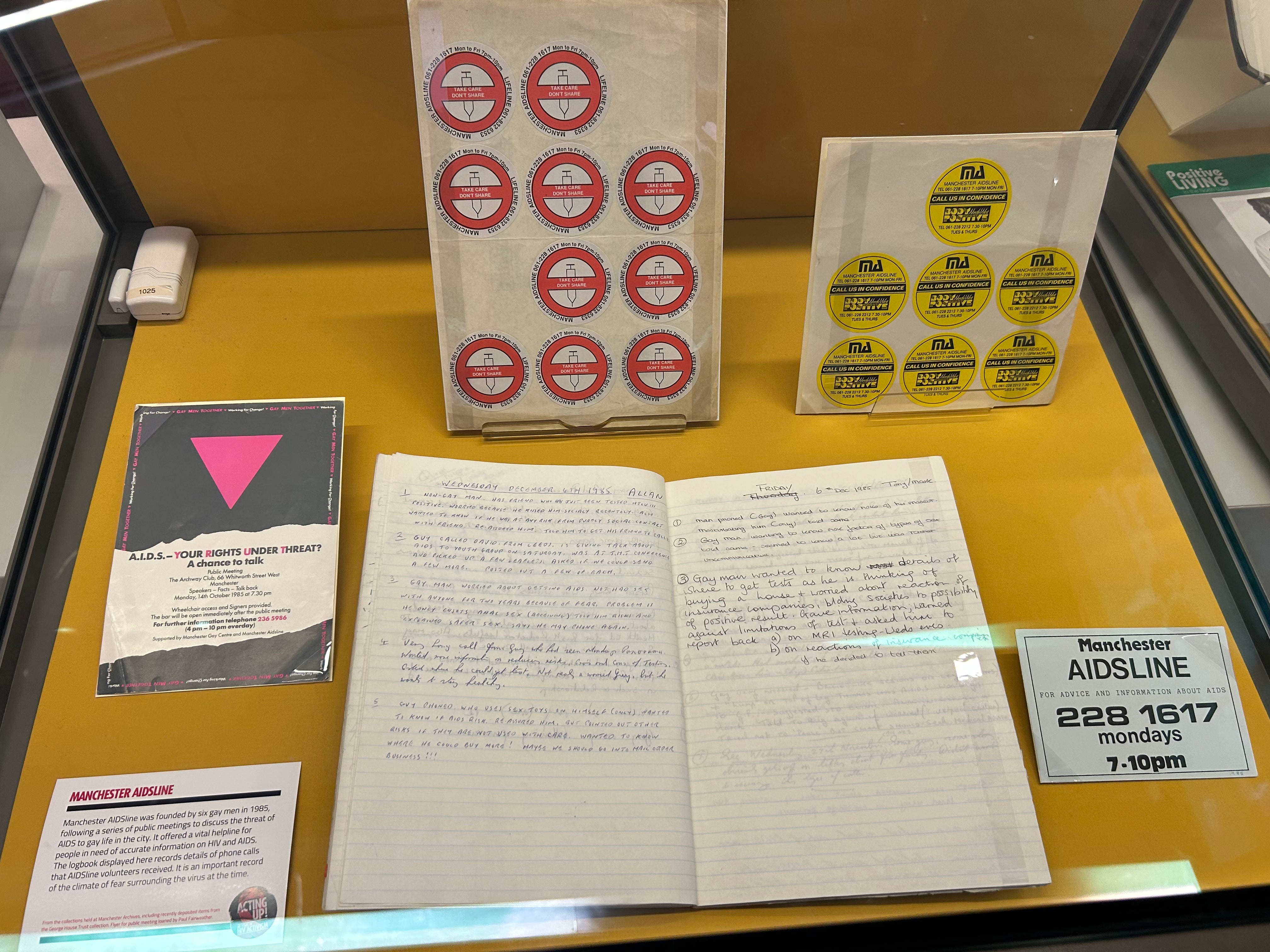
Above: Manchester AIDSline exhibit, featuring helpline logbook for 4 December 1985.
Manchester Central Library is a magnificent neoclassical edifice designed by E. Vincent Harris and built in the 1930s. Its form is loosely inspired by the Roman Pantheon: a columned portico attached to a domed rotunda. The Library is currently hosting Acting Up! 40 Years of HIV Activism. In 1985, Manchester City Council appointed gay rights activist Paul Fairweather as the city’s first Gay Men’s Officer. They also appointed Lesbians’ Officers and set up an AIDS Working Party. That same year, the council gave a grant to six gay men to set up Manchester AIDSline, a volunteer-run helpline. The logbook for 4 December 1985 shows that a volunteer called Allan spoke with a gay man who had abstained from sex for two years out of fear of AIDS. Allan explained the risks and how to have safer sex. He may well have helped this man to enjoy sex again. More amusingly, Allan spoke with a man who engaged in solo sex play, using sex toys on himself only. Allan assured him that his risk of contracting AIDS thereby was minimal. Thus emboldened, the man asked where he could buy more sex toys! “Maybe we should go into mail order business!!!” Allan wrote in the logbook.
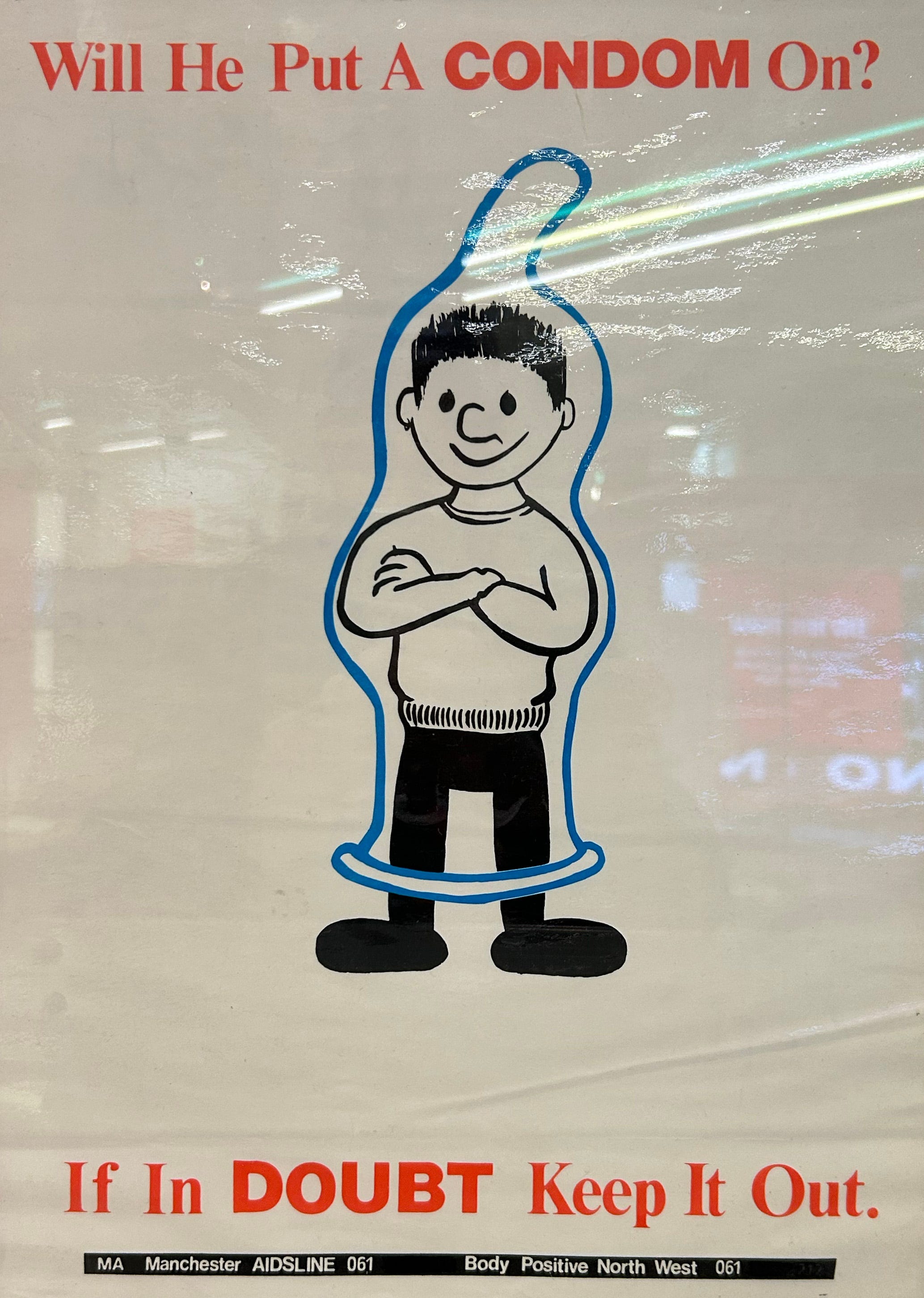
Above: Manchester AIDSline safer sex advert.
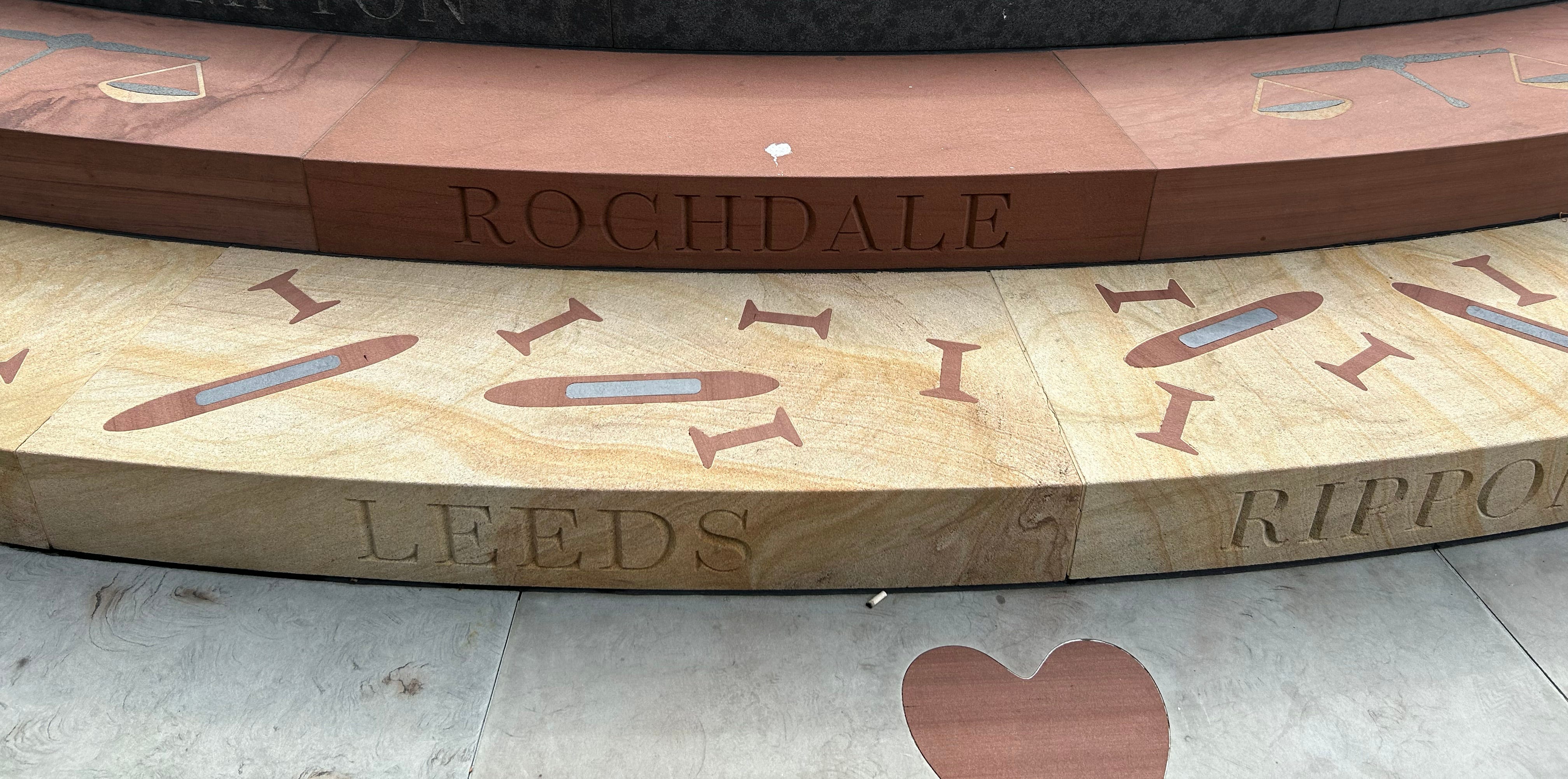
Paul Fairweather connects Manchester’s LGBT movement to a two hundred year tradition of radical protest that stretches all the way back to Peterloo.37 It was in this spirit that we added the Peterloo Memorial to our tour of gay Manchester. The memorial was designed by artist Jeremy Deller. It was unveiled in August 2019, exactly two centuries after the massacre that it commemorates. The monument features 11 concentric steps of polished and inlaid British stone, engraved with the names of the 18 people who died there and the towns they came from. There’s Rochdale, with its weavers’ shuttles! The names of Mary Heyes, Sarah Jones, and Margaret Downes are there, for there were women among the 50,000 Britons who rallied at Peterloo. Some of these women were members of the Manchester Female Reform Society, which had been formed the previous month with the aim of spreading democratic ideals among women. These brave women died demanding the “universal male suffrage” which was the most that Britain’s nascent Reform movement could imagine in 1819. They died so that their working class husbands and sons might vote, and although they dreamed of winning the franchise for themselves too, it would take another century of direct action by the Pankhursts and their legions of followers for British women to win the right to vote. The memorial also lists the “unborn child of Elizabeth Gaunt,” for the pregnant Gaunt was held in miserable conditions without trial for eleven days after the massacre, and she miscarried.
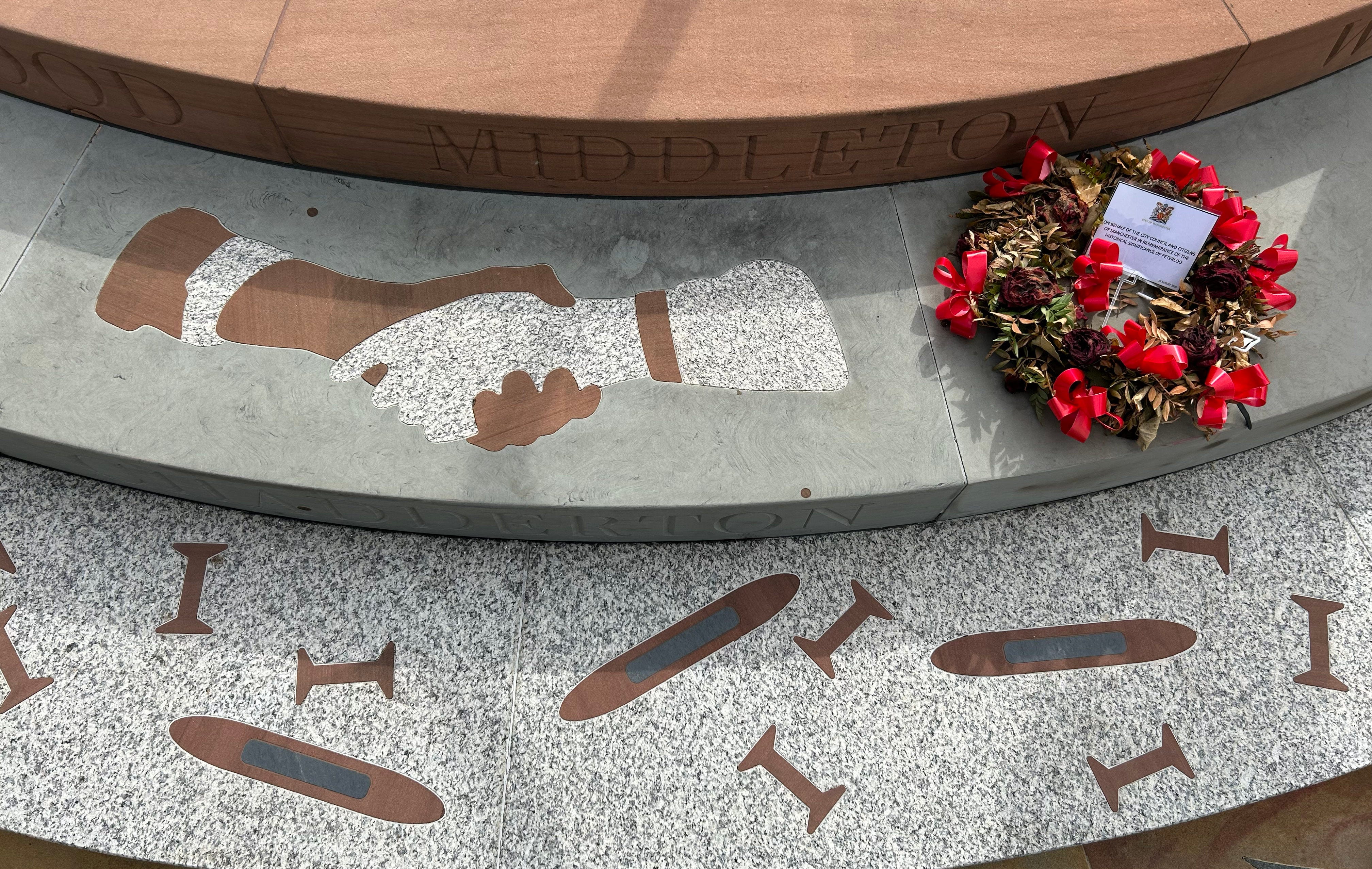
Above: Wreath laid on the Peterloo Memorial. Card reads: “ON BEHALF OF THE CITY COUNCIL AND CITIZENS OF MANCHESTER IN REMEMBRANCE OF THE HISTORICAL SIGNIFICANCE OF PETERLOO. 16 AUGUST 2025.”
The Peterloo massacre shocked the British conscience, and set Britain on the long and difficult path to political reform. The press dubbed it “Peterloo” because the same army that had just defended Britain against Napoleon at Waterloo had now turned its sabers against peaceful British protestors whose only “crime” was to demand the right to participate in electoral democracy. Shortly before he died of wounds he received at the rally, Waterloo veteran John Lees said this of the massacre: “At Waterloo there was man to man but there it was downright murder.” Two centuries later, Britain still remembers this outrage against basic human decency. Over in America, the Trump regime is busily erasing history, deleting all references to the fallen heroes of the civil rights movement, the women’s movement, the LGBT+ movement. Here in Manchester, the city council lays wreaths of flowers to honour the Peterloo martyrs on the 16th day of August each year.
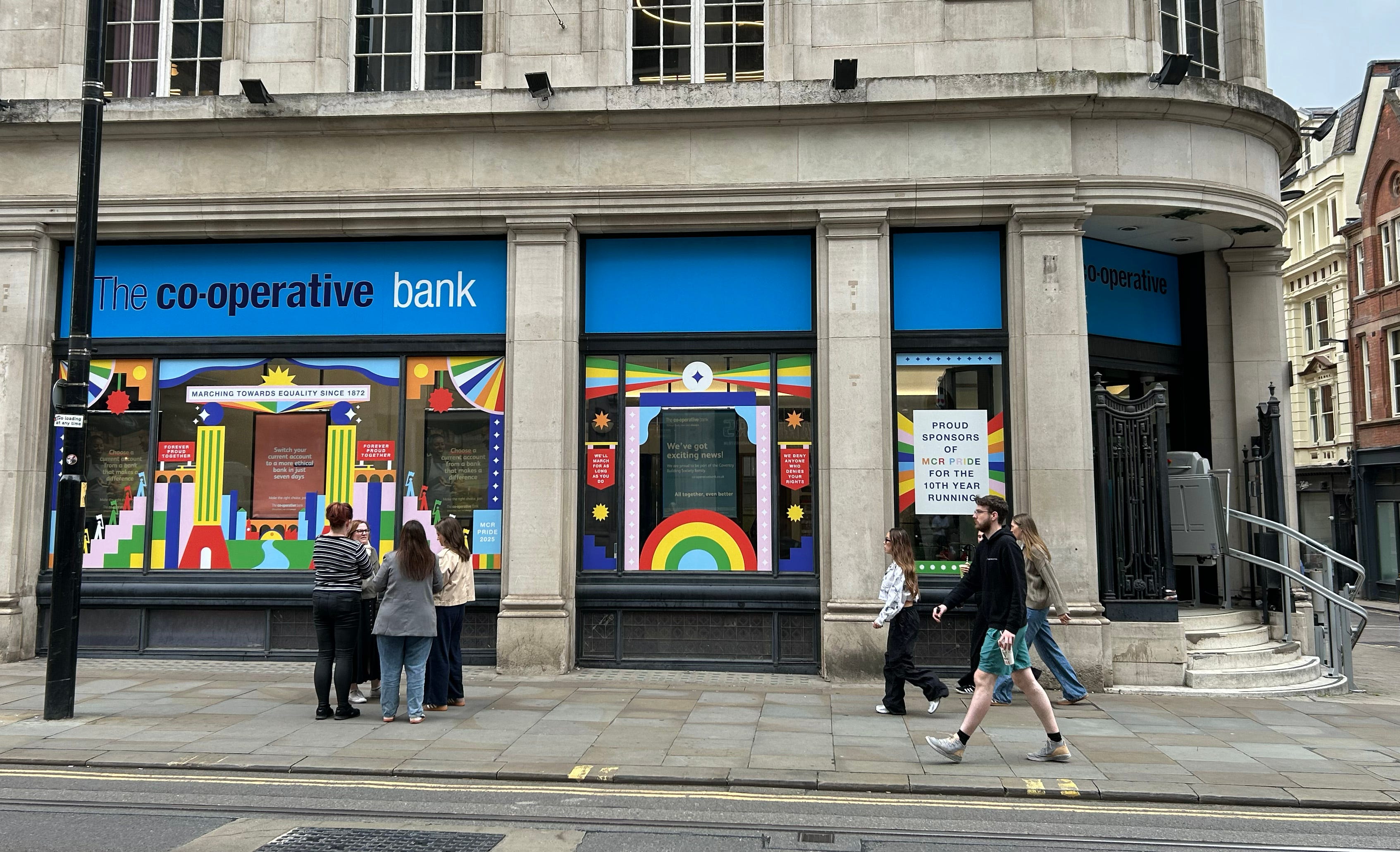
Today, gay Manchester extends well beyond the environs of Canal Street. Walking back to Victoria Station along Cross Street, we pass the bright rainbow Co-Op Bank, proud sponsors of MCR Pride for the 10th year running.38
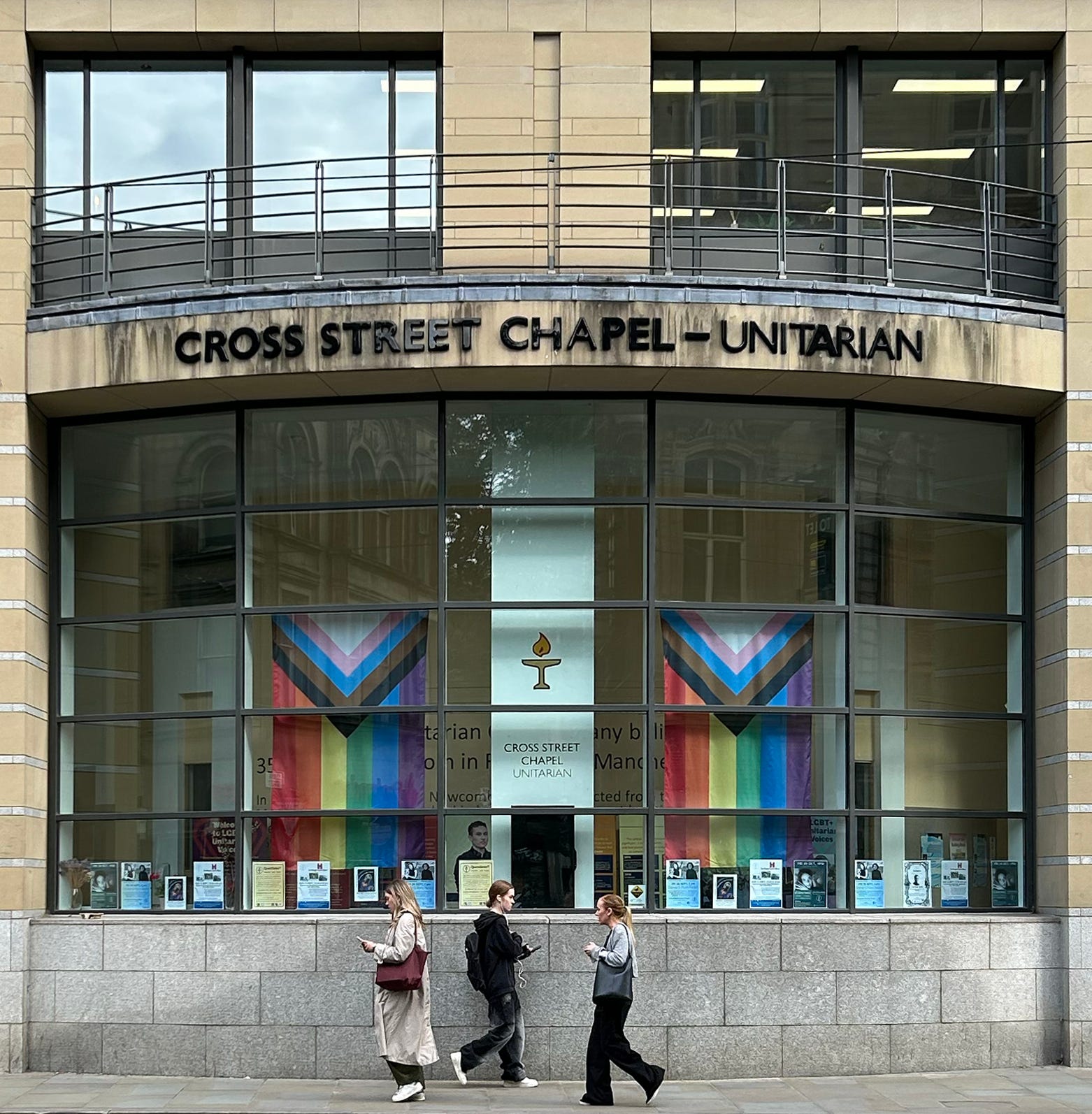
We pass the Unitarian Church’s Cross Street Chapel, delightfully unsubtle in its support of Lesbian, Gay, Bisexual, Transgender and Queer Mancunians.
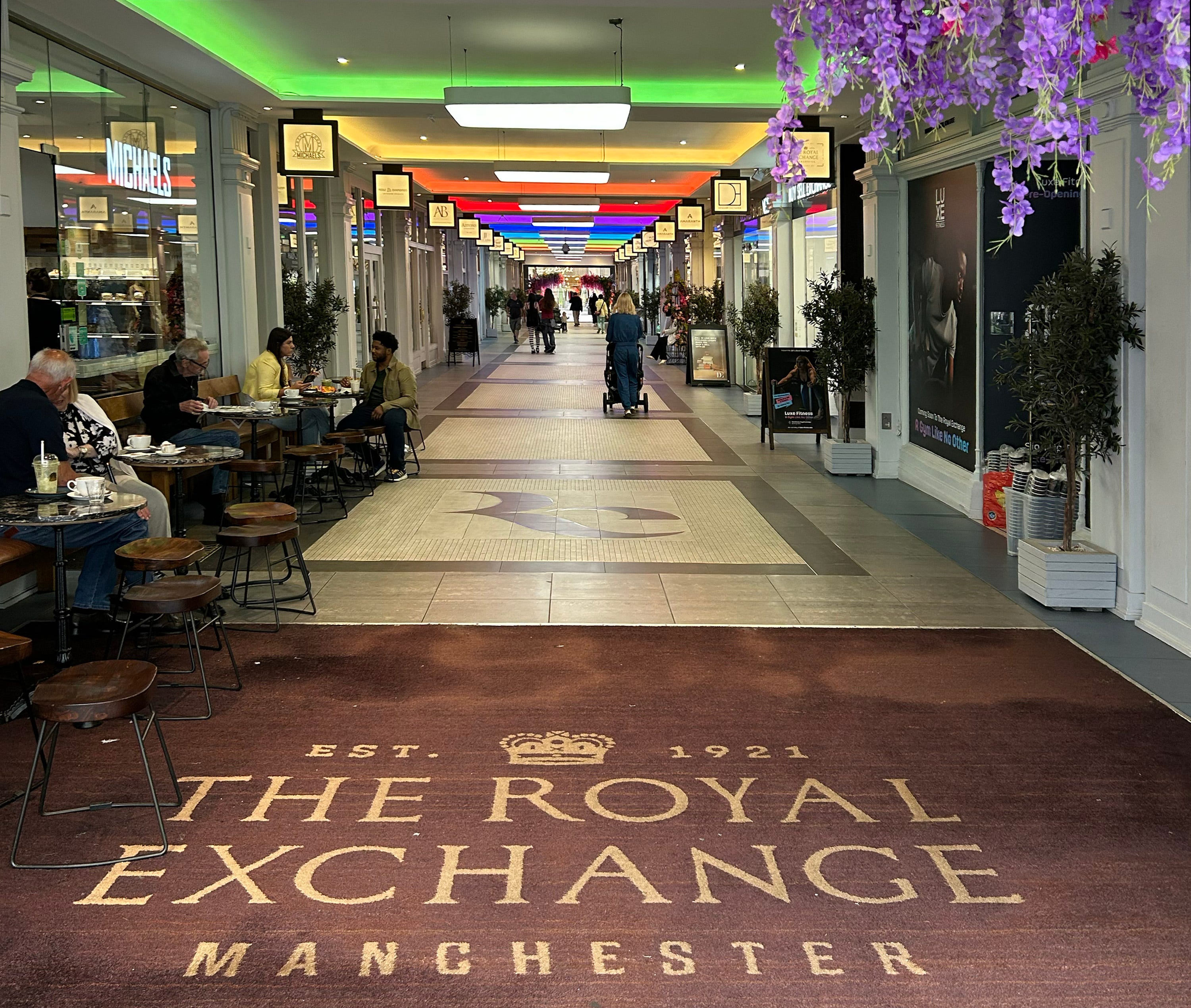
Even the staid Edwardian Royal Exchange, where Manchester’s cotton barons once sold their goods, affects a muted rainbow lighting scheme on its ceiling. As we near the station we pass Manchester Cathedral, which today flies St George’s Cross. But in August it flew a different flag, as all of Manchester joined Gay Village in a joyous celebration of Mancunian Pride.
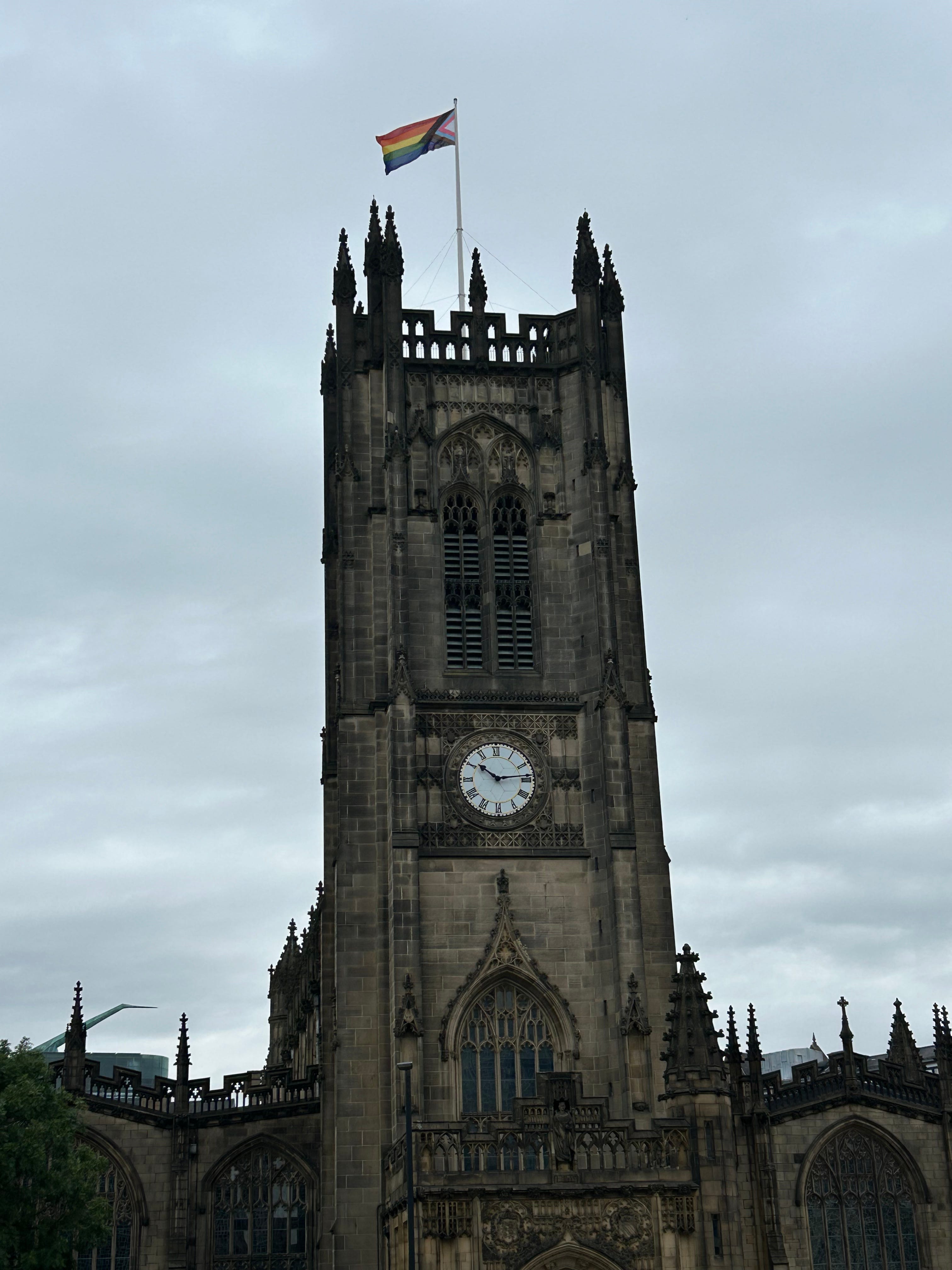
Above: Manchester Cathedral flies an inclusive LGBT Pride flag with transgender colours. 22 August 2025.
For a discussion of the Situationist practice of the dérive, and an example of a previous dérive in Manchester, see “Drifting towards decolonisation: Feel the emancipatory vibes.”
Alan Kidd, Manchester: A History (Lancaster: Carnegie, 2006), 246.
Kevin John Darbyshire, “Being Gay, Being Straight: An Anthropological Critique of Manchester’s Gay Village.” Ph.D. diss., London School of Economics and Political Science, 2007, p. 85.
Ibid., 10.
Ibid., 89.
Matt Cook and Alison Oram, “Gay and Civic Pride in ‘Madchester’” in Queer Beyond London (Manchester UP, 2002), 86.
Ibid., 85.
Ibid.
Ibid., 86.
Darbyshire, 92.
Darbyshire, 92, emphasis added.
Nina Held, “‘They look at you like an insect that wants to be squashed’: An ethnographic account of the racialized sexual spaces of Manchester’s Gay Village” Sexualities vol. 20 nos. 5-6 (2017), 539.
Kidd, 246.
Jon Binnie and Beverley Skeggs, “Cosmopolitan knowledge and the production and consumption of sexualized space: Manchester’s gay village.” The Sociological Review, vol. 61 (2004), 49.
Held, 540.
Annette Pritchard, Nigel Morgan and Diane Sedgley, “In Search of Lesbian Space? The Experience of Manchester’s Gay Village” in Tourism and Gender: Embodiment, Sensuality and Experience, ed. Annette Pritchard et al. (Wallingford, Oxfordshire: CABI, 2007), 279.
Ibid., 281.
Ibid., 282-283.
Ibid., 284.
Quoted in Cook and Oram, 86-87.
Held, 539.
Cook and Oram, 92.
Held, 543.
Ibid., 539.
Cook and Oram, 69-70.
Ibid., 72.
Ibid., 74.
Ibid., 77.
Pritchard et al., 283.
Cook and Oram, 88.
Ibid.
He was assisted in this noble endeavour by the officers and ratings of the Women’s Royal Naval Service, commonly known as the Wrens. See “Wren Bombes Win War! Nazis crushed by division of women codebreakers led by queer man.”
This was actually the second time in as many weeks that Michelle and I had stumbled into a Wonderland tea party. The Mad Hatter himself was throwing one when we were at Lancaster Castle. An amphibious green gentleperson was keeping the guest list on a long scroll. Michelle had to try her first and middle names and then impersonate Alice to get in. But I finally learned, after living just six decades on this mad planet, that my given name will always be on the guest list of any Wonderland party.
Binnie and Skeggs, 47.
Cook and Oram, 91.
And what, you may well ask, is a rarebit? Well, it is a “rare bit,” probably in the sense of a delicacy. But rarebit is short for Welsh rarebit, which is itself an alteration of “Welsh rabbit.” And this bold, implausible phrase was formed by combining the adjective meaning “from Wales” with a noun describing a small burrowing mammal, “probably humorously,” for this dish contains no rabbit nor any other meat. It is, in fact, mustard-infused cheese melted on toast, preferably served with a nice onion chutney or marmalade. Yum! Still, you can understand why a vegetarian from America might hesitate when first offered a dish named after an animal that Sam Gamgee would gladly stew up with some nice taters and serve to Mr Frodo. Especially if that American vegetarian were offered this delicacy in a place that’s not particularly near Wales, such as the Gordon Rigg bistro in Rochdale, just as an example. I digress, but such is the nature of the dérive. See Oxford English Dictionary, s.v. “rarebit,” “Welsh rarebit, “Welsh rabbit,” &c.
Quoted in Cook and Oram, 70.
On the historical origins of the British co-operative movement through the good work of the Rochdale Society of Equitable Pioneers, see “Birthplace of co-operation, innit? That ‘inexplicable district of Lancashire!’”